Perhaps it happens when your four-year-old comes home from school, excited to show you their work. They proudly present a carefully traced pentagon adorned with elaborate, colorful patterns they designed themselves.
Or maybe it happens when your eight-year-old casually references acute-angled scalene triangles at the dinner table.
Regardless of when it occurs, as Montessori parents, there comes a moment when we become acutely aware (pun intended!) of our children’s depth of geometric knowledge. Many of us recall our own introduction to geometry occurring much later—typically in high school, and often without the joy and enthusiasm our children display today. We notice that our children are not only capable of understanding these concepts, but that exploring them fills them with genuine fascination and satisfaction.
How does a Montessori education make complex mathematical concepts so accessible and engaging from an early age?
Dr. Maria Montessori discovered that young children are developmentally primed to absorb concepts traditionally reserved for much older students when those concepts are introduced sensorially, concretely, and sequentially. Geometry is a brilliant example of this approach in action.
The Primary Years: Building a Concrete Foundation (Ages 3–6)
In the Primary classroom, much of a child's geometry work begins indirectly. While children refine crucial motor skills, they do so through materials that quietly lay the foundation for advanced geometric thinking.
- The Metal Insets: Children use metal frames to trace a wide variety of figures—including squares, triangles, circles, ovals, curvilinear triangles, and quatrefoils. While the primary goal of this work is pencil control and muscle preparation for writing, it simultaneously embeds the precise shapes into the child's visual and muscle memory.
- Geometric Solids: Children hold, name, and explore three-dimensional wooden shapes—such as cubes, spheres, ovoids, and square-based pyramids. Learning is tactile first; children feel the curves, edges, and vertices before learning their formal names.
- The Geometry Cabinet: This material consists of series of drawers organized by shape families—polygons, triangles, curvilinear figures, and rectangles. Children remove wooden inset pieces, trace their outlines with their fingers, and fit them back into their frames, refining spatial perception and precise vocabulary.
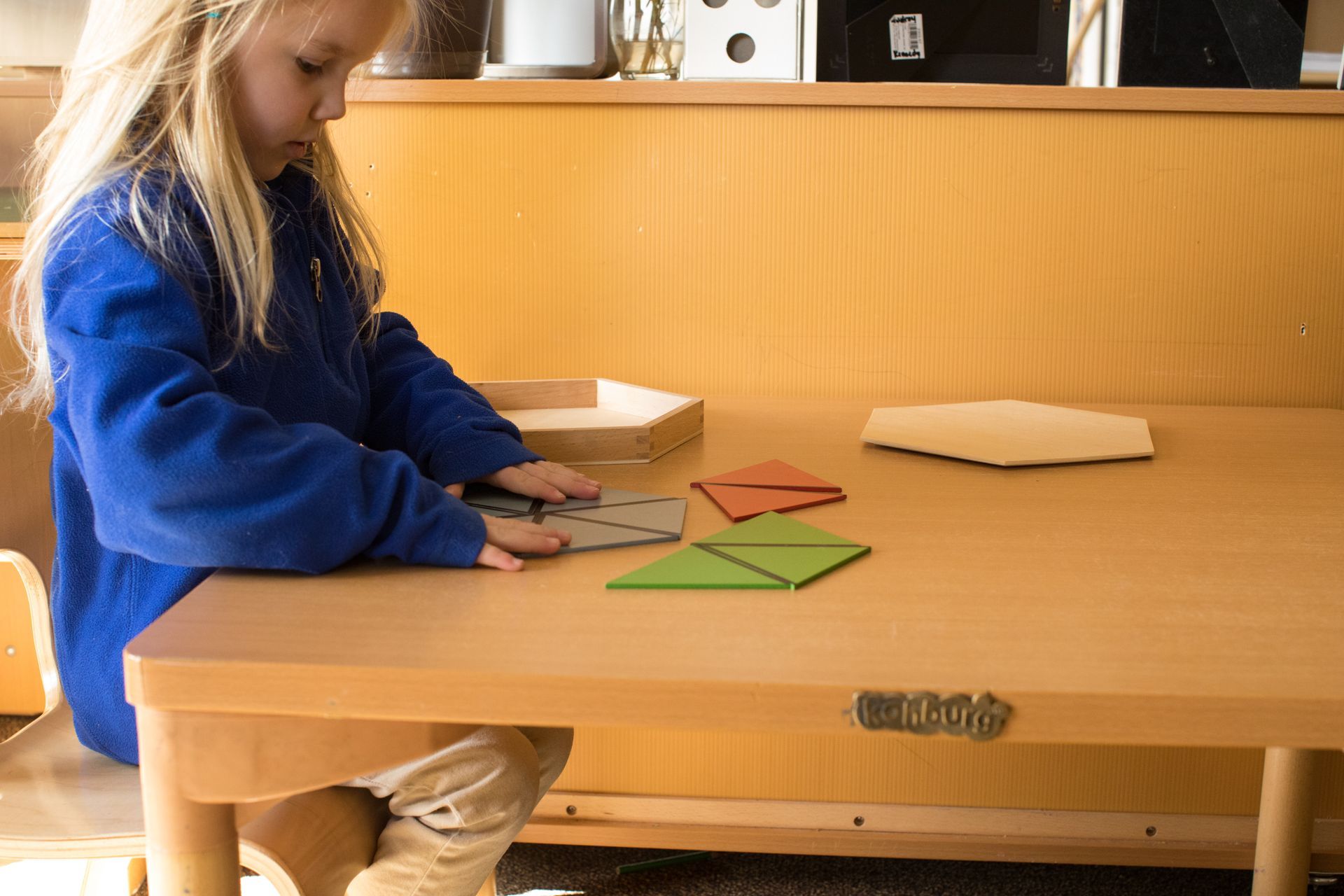
- Constructive Triangles: Through a series of specialized wooden boxes, children manipulate different types of triangles to construct new shapes, discovering firsthand how triangles form the basis of all other plane figures.
During these foundational years, the emphasis is on sensory exploration, movement, and precise language, allowing children to construct a clear mental framework through hands-on practice.
The Elementary Years: From Concrete to Abstract (Ages 6–12)
In the Elementary classroom, the geometry curriculum expands exponentially to meet the child’s burgeoning reasoning mind and capacity for abstract thought.
Lower Elementary (Ages 6–9)
Work begins with a detailed study of nomenclature (the systematic naming of concepts). Using specialized cards, booklets, and concrete materials, children explore and construct their own reference books.
- Fundamental Concepts: Lessons begin with the basic definitions of a point, line, surface, and solid, before advancing to complex classifications of lines (straight, curved, ray, line segment) and their relationships (parallel, convergent, divergent, perpendicular).
- Angles & Polygons: Children as young as seven learn to classify, measure, and construct angles. By age eight, they explore regular and irregular polygons, as well as the geometric principles of congruency (same shape, same size), similarity (same shape, different size), and equivalency (different shape, same area).
- Measurement: Children begin practical explorations of perimeter and area using concrete floor and table materials.
Upper Elementary (Ages 9–12)
As children transition into upper elementary, geometry bridges visual spatial relationships and abstract numerical expressions.
- Formula Derivation: Rather than memorizing formulas for perimeter, area, and volume, students derive the formulas themselves using materials they have worked with since age three.
- Real-World Application: Students apply geometric formulas to measure real-world objects, architectural spaces, and natural forms.
- Mathematical History & Patterns: Children explore historical and mathematical connections, such as the Pythagorean theorem and the Fibonacci sequence, appealing to their developing interest in patterns, order, and the history of human innovation.
Supporting Your Child's Journey
Throughout their time at Chesterbrook Montessori School, children transition seamlessly from concrete exploration to abstract mathematical thinking. In the Primary years (ages 3–6), the focus centers on sensorimotor exploration and acquiring precise terminology through materials like the Metal Insets, Geometric Solids, Geometry Cabinet, and Constructive Triangles. As children move into Lower Elementary (ages 6–9), their study expands into detailed nomenclature, spatial relationships, and foundational measurement using specialized nomenclature cards, geometric sticks, protractor work, and area grids. By Upper Elementary (ages 9–12), students apply these concepts to deriving formulas, working abstractly, and exploring real-world applications through advanced theorem materials, volume cubes, and historical geometry.
The next time your child shares an unexpected geometric insight, you can celebrate knowing it is the result of years of rich, hands-on exploration.
If you would like to observe how geometry lessons unfold in our Primary and Elementary classrooms, or if you have questions about our mathematics curriculum, please schedule an observation at Chesterbrook Montessori School. We are always happy to share our environments with you.